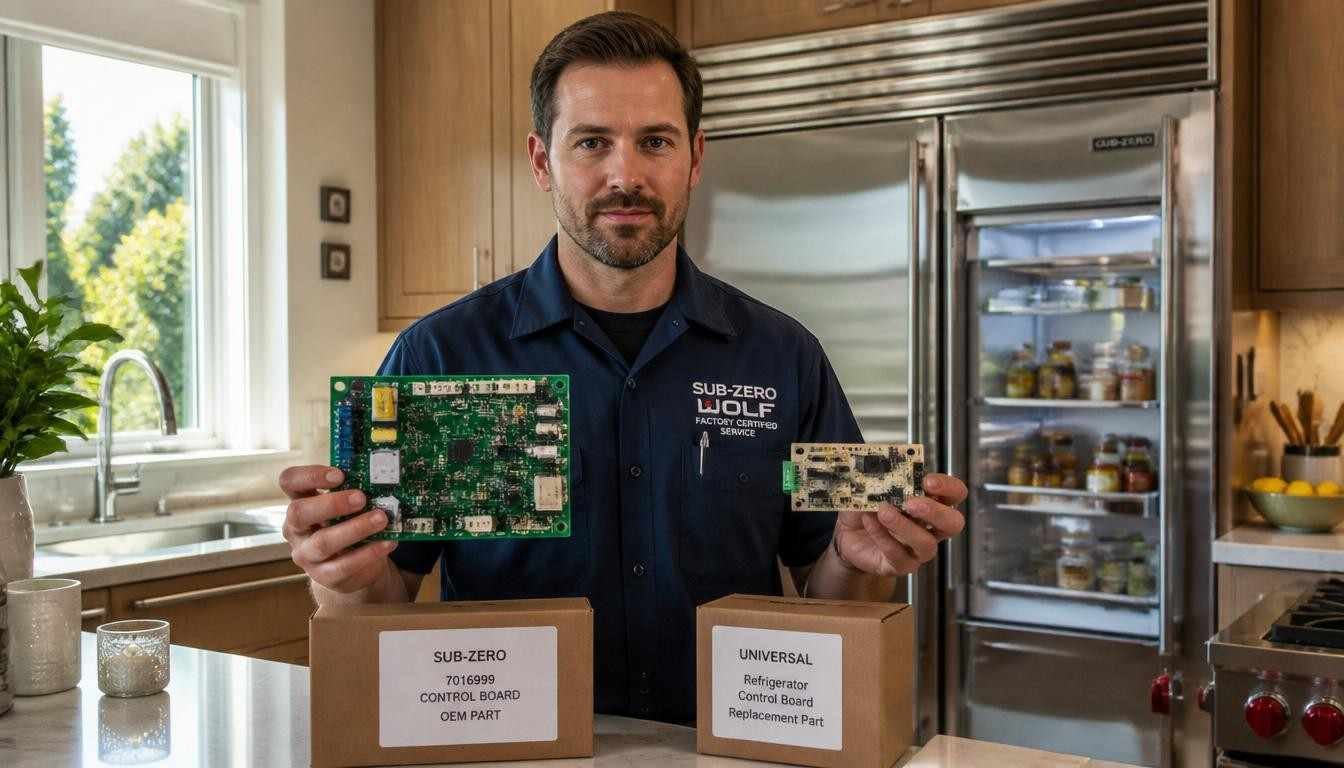
When your $3,000 refrigerator or $4,500 range breaks down, you want a quick fix. You see a “universal” replacement part online for half the price of the original. It promises to fit multiple models. It looks like a smart save. But here’s the truth: universal parts are a bad investment for high-end appliances, and they will cost you more in the long run.
You might lose your warranty. Your appliance could perform worse. In some cases, one bad part ruins other components. This guide explains why original equipment manufacturer (OEM) parts matter, especially for luxury brands like Wolf, Sub-Zero, Miele, and Thermador. You’ll see real costs, failure patterns, and how to find genuine parts in Lake Elsinore, CA.
The Hidden Cost of “One-Size-Fits-All” Repair
When you buy a universal part, you’re betting on a gamble. The seller claims it fits “most models.” But your high-end appliance is not most models. It’s engineered with precision. Universal parts ignore that precision. They save you money today but cost you three times more next year.
In Lake Elsinore, we repair luxury appliances daily. We see the damage universal parts cause. Homeowners save $50 on a control board. Six months later, the board fails. The warranty is void. Commercial businesses face worse costs. Higher usage means faster failure. One bad universal part can shut down a restaurant for hours.
What Defines a “Universal” Appliance Part in 2026?
Universal parts are aftermarket replacements labeled as compatible with multiple brands or models. Sellers call them “one-size-fits-all.” You find them on Amazon, eBay, and generic parts sites. They work for simple items like water filters or drain hoses. But complex components like control boards, motors, and heating elements rarely match your high-end appliance’s exact specs.
Manufacturers do not test universal parts on every model. They guess compatibility. Your Wolf oven might need a heating element at 120 volts. The universal version runs at 130 volts. That mismatch damages your control board. Universal parts are not built to the same standards as OEM parts.
Why High-End Appliances Demand More Than Generic Replacements
Luxury appliances use precision engineering. A Wolf oven’s heating element operates at specific voltage and temperature ranges. A Sub-Zero refrigerator’s compressor maintains exact pressure levels. Universal parts ignore these specs. They fit loosely or run at wrong temperatures. Your appliance works harder, wears faster, and fails sooner.
Think about your car. You do not put a $10 generic spark plug in a Ferrari. You use the exact part the manufacturer designed. Your high-end appliance is the same. It needs the exact part, not a “close enough” version. Generic replacements save money short-term but destroy long-term value.
The Lake Elsinore CA Repair Reality: Residential and Commercial Impact
In Lake Elsinore, we see this daily. Residential homeowners save $50 on a universal control board. Six months later, the board fails again, and the warranty is void. Commercial businesses face worse costs. Higher usage means faster part failure. One bad universal part in a restaurant dishwasher can shut down operations for hours. You need OEM parts for reliability, whether you’re a homeowner or a business owner.
Local climate adds to the problem. Lake Elsinore has hard water and hot summers. These conditions stress appliances. Universal parts wear out faster in this environment. OEM parts are built to handle it. Learn more about how our climate affects appliance life in our Lake Elsinore vs Your Appliances guide.
The Technical Mismatch: Why Universal Parts Fail on Luxury Appliances
Universal parts fail because they do not match your appliance’s technical requirements. High-end appliances run on tight tolerances. Voltage, temperature, pressure, and connector shapes must be exact. Universal parts are not exact. They are “close enough.” That closeness breaks your appliance.
We’ve seen universal heating elements burn out oven wiring. We’ve seen generic control boards short out compressors. We’ve seen poorly matched connectors cause sparks. These are not rare problems. They happen every week in Lake Elsinore repair shops.
You’ll learn about voltage mismatches, firmware issues, material quality, and proprietary connectors. These are the real problems, not marketing claims.
Precision Specifications: Voltage, Temperature, and Pressure Requirements
High-end appliances operate within tight tolerances. Your Miele dishwasher uses 120 volts at 15 amps. A universal heating element might draw 130 volts. That 10-percent spike damages your control board. Refrigerator compressors need exact pressure (often 150–200 psi). Universal compressors run at 140 psi or 220 psi. The mismatch causes poor cooling, higher energy use, and premature failure.
Temperature is another issue. Wolf ovens heat to 500°F with precision. Universal heating elements overshoot or undershoot. Your food cooks unevenly. The element burns out in months instead of years. Pressure matters in refrigerators too. Sub-Zero compressors maintain exact pressure for optimal cooling. Universal compressors fail the test. Your fridge runs longer, uses more electricity, and wears out faster.
Control Boards and Smart Technology: Universal Parts Can’t Hack Firmware
Smart appliances use firmware to manage temperature, cycles, and sensors. Your LG Wi-Fi fridge communicates with your phone. A universal control board lacks the firmware. It might power on, but sensors fail. The appliance runs long cycles, heats unevenly, or shows error codes. In 2026, 87 percent of appliance problems involve smart technology components. Universal parts cannot replace these.
Firmware is software. It tells the appliance how to work. Universal boards come with generic software. Your appliance needs specific software. The mismatch causes errors. You get error codes like “E10” or “F25.” The appliance stops working. You call a technician. They replace the board with OEM. Now you paid twice.
Material Quality: Generic Components vs. OEM Durability
OEM parts use high-grade steel, copper, and ceramics. Universal parts use cheap metals and plastic. A Wolf oven’s OEM heating element lasts 10–15 years. A universal element lasts 2–3 years. The difference comes from material thickness and heat resistance. Generic parts corrode faster, especially in Lake Elsinore’s hard water climate.
Copper wiring is thicker in OEM parts. It handles heat better. Universal wiring is thin. It burns out. Steel is stronger in OEM parts. It does not crack. Universal steel cracks under stress. You see this in dishwasher pumps and refrigerator fans. The part breaks. You replace it. It breaks again. OEM parts last. For hard water solutions that protect your appliances, check our hard water guide for Lake Elsinore residents.
Proprietary Connectors: Why “Almost Fits” Still Breaks Your Appliance
Luxury brands use unique connector shapes. A Thermador range has a 6-pin male connector. Universal parts use 4-pin or 8-pin connectors. You force them to fit. The connection is loose. Sparks happen. Your appliance shorts out. “Almost fits” means it does not fit at all.
Forcing connectors damages wiring. You strip the pins. The connection becomes unreliable. Your appliance works intermittently. It turns on, then off. Error codes appear. You replace the part. It still fails. The wiring is damaged. You need new wiring now. One bad connector costs you $500 in repairs.
Financial Fallout: Real Cost Comparisons (OEM vs. Universal)
Universal parts look cheaper. You save $40 today. But they fail faster. You pay again in six months. Over three years, you spend $400 on universal parts instead of $80 on one OEM part. The “savings” is a loss.
Repair costs in 2026 are rising. Tariffs add 5–20 percent. OEM parts rose 8–15 percent since 2025. But durability matters more when prices go up. You want one fix, not three. Commercial users face even worse costs. Higher usage means faster failure. Cost-per-use for universal parts is 5 times higher than OEM.
You’ll see average repair costs, control board prices, the 50% rule, utility bill increases, tariff impacts, and commercial cost-per-use. These are the facts, not guesses.
Upfront Savings vs. Long-Term Expenses: The 15–35% OEM Premium Myth
OEM parts cost 15–35 percent more than universal alternatives. You save $40 now. But universal parts fail 3–5 times faster. Over three years, you buy three universal parts ($120 total) instead of one OEM part ($80). The “savings” is a loss.
Let’s say a control board costs $400 OEM or $150 universal. Universal fails after 6 months. You buy it again. Six months later, it fails again. Total cost: $450 for three universal parts. OEM lasts 3 years. Total cost: $400. You save $50 with OEM. The math is clear.
Average Repair Costs in 2026: Refrigerator ($200–$300), Oven ($100–$500)
In 2026, average repair costs vary by appliance. Refrigerators: $200–$300. Ovens and ranges: $100–$500. Dishwashers: $160–$300. Microwaves: $50–$400. These prices include parts and labor. If you use a universal part, expect to pay again within six months.
Universal parts make repairs cheaper short-term. But they fail faster. You reach the repair cost threshold sooner. See our guide on repair-or-replace cost-benefit analysis to decide wisely.
Control Board Replacement: $300–$800+ for Smart Appliances
Smart appliance control boards cost $300–$800. A universal board might be $150. But it lacks firmware. Your appliance shows error codes or stops working. You call a pro to fix it. Now you pay $150 (universal part) + $200 (labor) + $300 (OEM replacement) = $650 total. The OEM part alone would cost $400.
Logic is simple. Buy OEM. You pay once. Universal costs twice.
The 50% Rule: When Repair Costs Justify Replacement Instead
The 50% rule says: if repair costs exceed 50 percent of appliance value, replace it. A $4,000 Wolf range should not cost more than $2,000 to repair. Universal parts make repairs cheaper short-term, but they fail faster. You reach the 50% threshold sooner.
Universal parts push you toward replacement. OEM parts keep appliances running longer. You save money over time.
Hidden Utility Bill Increases from Poor-Performance Universal Parts
Universal parts work inefficiently. Your fridge runs longer to cool. Your oven uses more heat to reach temperature. This spikes your electric bill. Signs include longer cycles, uneven heating, and higher monthly costs. Check our article on 5 signs your appliances increase your electric bill to spot these issues.
A universal compressor might use 20 percent more electricity. That’s $30 extra per month. Over a year, $360. The “savings” on the part is gone.
Rising Costs: Tariffs Adding 5–20% to Parts, OEM Up 8–15% Since 2025
Tariffs on imported parts from China and Mexico add 5–20 percent to costs. OEM parts rose 8–15 percent since January 2025. Universal parts also increased, but they still fail faster. The rising cost makes durability more important. You want one fix, not three.
Price hikes make OEM parts more valuable. They last longer. You do not replace them. Universal parts need replacement. You pay more over time.
Commercial Impact: Higher Volume = Faster Universal Part Failures, Worse Cost-Per-Use
Commercial appliances run 10–20 hours daily. A restaurant dishwasher cycles 100+ times per day. Universal parts wear out in weeks. OEM parts last months.
Downtime is expensive. A broken dishwasher shuts down service. You lose customers. OEM parts prevent this.
Warranty and Liability: What Manufacturers Say About Universal Parts
Most luxury brands void warranty if non-OEM parts are installed. One technician spots a universal part, and your warranty is gone. You pay for all future repairs. This is not a rumor. It’s in the warranty policy.
Right-to-repair laws are changing. The EU requires spare parts by July 2026. The US has no federal law yet. But even with right-to-repair, brands still require OEM parts for warranty. Insurance may deny claims if universal parts caused damage.
Warranty Voidance: How Generic Parts Nullify Luxury Brand Coverage
Most luxury brands void warranty if non-OEM parts are installed. Wolf, Sub-Zero, Miele, and Thermador state this clearly in their policies. One technician spots a universal part, and your warranty is gone. You pay for all future repairs.
Technicians check for OEM marks. They see “universal” on the part. Warranty is void. You lose $2,000 in coverage.
High-End Brand Policies: Wolf, Sub-Zero, Miele, Thermador Warranty Terms
Wolf and Sub-Zero offer 2-year parts and labor warranties. Miele gives 1–5 years depending on the model. Thermador provides 2 years. All require OEM parts for coverage. Check your brand’s warranty terms before buying generic. Learn how to find the model number on any major home appliance to verify your warranty status.
Your model number tells you the warranty period. Check it before repairs.
Right-to-Repair Laws in 2026: What’s Changing (EU vs. US)
The EU Right-to-Repair directive (2024/1799) requires manufacturers to provide spare parts by July 2026. The US has no federal law yet. Some states propose similar rules. But even with right-to-repair, luxury brands still require OEM parts for warranty. The law does not change this.
Right-to-repair helps you get parts. It does not change warranty rules.
Insurance Claims: Will Universal Parts Affect Your Coverage?
Home insurance may deny claims if universal parts caused damage. If a universal heating element sparks and burns your kitchen, insurers could say you used unsafe parts. OEM parts reduce this risk. They meet safety standards.
OEM parts are tested. Universal parts are not.
Real-World Failure Patterns: When Universal Parts Cause Damage
Universal parts fail in predictable ways. Shorter lifespan. Performance issues. Secondary damage. Smart appliance failures. We’ve seen all of these in Lake Elsinore.
You’ll see how universal parts wear out faster, cause performance problems, damage other components, and fail on smart appliances. These are the problems you avoid with OEM parts.
Shorter Lifespan: Generic Materials Wear Out Faster
Universal parts fail 3–5 times faster than OEM. A generic motor lasts 2 years. An OEM motor lasts 10 years. Your appliance’s life expectancy drops. Check our appliance life expectancy guide to see typical lifespans.
You replace the part more often. Cost goes up.
Performance Degradation: Longer Cycles, Temperature Fluctuations
Your dishwasher runs 3 hours instead of 2. Your oven heats to 325°F instead of 350°F. Universal parts cause these issues. You notice longer cook times, uneven baking, and poor cleaning.
Food comes out bad. You redo the meal. Time and money lost.
Secondary Damage: How One Bad Part Ruins Other Components
A universal control board shorts out. It damages your compressor, sensors, and wiring. One $150 part costs $1,200 in replacements. This is common with smart appliances.
One bad part ruins the whole system.
Smart Appliance Brittleness: 23% Wi-Fi Board Failure Rate in 18 Months
Smart appliances have higher failure rates. Wi-Fi boards fail 23 percent within 18 months. Universal boards fail faster. Avoid them on connected appliances.
Smart means fragile. Universal makes it worse.
How to Identify OEM vs. Aftermarket Parts (Before You Buy)
You need to spot OEM parts before you buy. Packaging shows the brand. Price is higher. Supplier is authorized. Technician confirms.
You’ll learn packaging signals, price red flags, supplier verification, and why technicians help.
Packaging Signals: Brand Logos, Part Numbers, and Certification Marks
OEM packaging shows the brand logo (Wolf, Miele, etc.). It has a part number matching your appliance manual. Certification marks like UL or CSA appear. Universal packaging looks generic. No brand name. No exact part number.
Check the box. Look for the logo.
Price Red Flags: When “Too Cheap” Means Aftermarket
If a $400 control board is $150, it’s aftermarket. OEM parts cost more. Check prices against official brand sites. See 15–35% OEM premium for typical differences.
Too cheap is a warning.
Supplier Verification: Trusted OEM Distributors vs. Generic Sellers
Buy from authorized distributors. Brands list them on their websites. Avoid Amazon sellers with no credentials. Use our finding reliable appliance repair in Riverside County guide to find trusted sources.
Buy from authorized sellers only.
Ask Your Technician: Why Professional Diagnosis Prevents Mistakes
A certified technician identifies the exact part needed. They know OEM vs. universal. Technicians prevent mistakes.
When Universal Parts Actually Work (The Exceptions)
Universal parts work for simple items. Water filters. Drain hoses. Gaskets. Handles. Brackets. Fasteners.
But never on motors, boards, or heating elements. You’ll learn when universal parts are safe and when they are not.
Simple Components: Water Filters, Drain Hoses, Gaskets
Universal water filters work for most models. Drain hoses and gaskets also fit broadly. These are low-risk items.
Safe to use universal here.
Non-Critical Items: Door Handles, Shelf Brackets, Basic Fasteners
Handles and brackets do not affect performance. Universal versions save money safely.
No performance risk.
The Rule: Avoid Universal Parts on Motors, Control Boards, Heating Elements
Never use universal parts on motors, boards, or heating elements. These are high-risk. They control voltage, temperature, and pressure. Stick with OEM.
High-risk = OEM only.
Best Practices for High-End Appliance Owners in Lake Elsinore, CA
You need action steps. Schedule maintenance. Use certified technicians. Keep OEM records. Get diagnostic waived. Residential users protect warranty. Commercial users need reliability.
You’ll learn maintenance, technician selection, record keeping, diagnostic tips, and audience-specific advice.
Schedule Regular Maintenance: Prevent Breakdowns Before They Happen
Annual maintenance cuts breakdowns by 40 percent. We service refrigerators, ranges, dishwashers, and HVAC systems. Learn about Lake Elsinore climate effects on appliances.
Maintenance prevents problems.
Keep OEM Part Records: Documentation for Warranty Claims
Save receipts for OEM parts. They prove warranty compliance. Receipts protect warranty.
Residential Users: Warranty Protection and Home Value Considerations
Homeowners protect warranty and home value. OEM parts keep appliances running longer. Protect your investment.
Commercial Users: Higher Usage Demands Require OEM Reliability
Businesses need reliability. OEM parts prevent downtime.
Reliability = no downtime.
Conclusion: Protecting Your Investment Means Choosing OEM Parts
Universal parts cost more over time. OEM parts last longer, work better, and keep warranties valid.
Take action. Call a technician. Get OEM parts. Avoid universal on high-risk components. Schedule maintenance yearly.
The Bottom Line: Universal Parts Cost More Over Time
Universal parts save $40 now but cost $400 later. OEM parts last longer, work better, and keep warranties valid. Math is clear. Buy OEM.
Action Steps: What to Do When Your High-End Appliance Breaks
- Call a certified technician.
- Get OEM part replacement.
- Avoid universal parts on motors, boards, and heating elements.
- Schedule maintenance yearly.
Visit Appliance Repair Lake Elsinore for appliance and HVAC repair services in Lake Elsinore.
Contact us for appliance and HVAC repair services in Lake Elsinore. We serve residential and commercial customers.