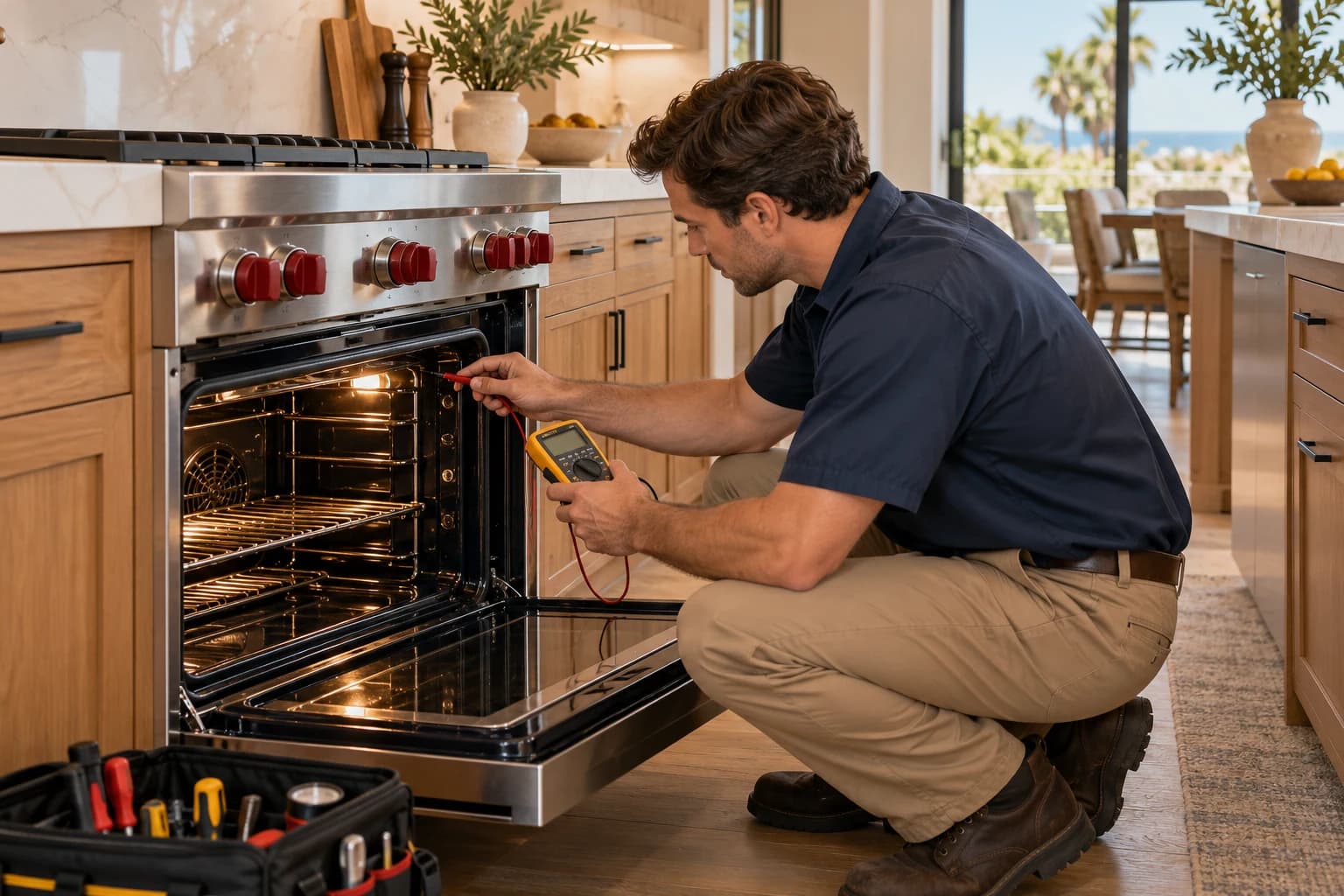
The refrigerator calls start in late June. By mid-July they are a daily pattern: a fridge that has been fine for years is suddenly warm, or running constantly, or making a noise it did not make in April. The homeowner assumes something broke. Usually, nothing broke. The refrigerator simply hit a summer it could not keep up with, and the reasons are specific to where Lake Elsinore sits.
This guide explains the heat effect, why it hits refrigerators here harder than in coastal cities, the one maintenance task that prevents most of the summer calls, what to do about garage units, and which symptoms mean the damage is already happening.
The valley basin heat effect
Lake Elsinore sits in a basin ringed by hills. Hot air settles in the valley during the day and does not drain out as readily as it does in cities with a sea breeze. Summer temperatures regularly reach 100 degrees Fahrenheit, and the heat is sustained rather than spiking for an afternoon and dropping overnight.
For a refrigerator, ambient temperature is the whole job. A refrigerator does not make cold; it moves heat from inside the cabinet to the outside through the condenser coils, and the hotter the air around those coils, the harder that transfer becomes. Every degree of kitchen temperature above the design assumption adds to the compressor's workload. A kitchen that sits at 85 degrees on a July afternoon because the air conditioning is struggling asks a lot more of the refrigerator than a kitchen at 72.
Then there is the dust. Santa Ana wind season deposits fine dust across the basin, and that dust settles exactly where it does the most harm: on the condenser coils at the back or bottom of the refrigerator. A coating of dust acts as insulation. The coils cannot shed heat into the kitchen, so the refrigerant stays hotter, the cabinet stays warmer, and the compressor runs 20 to 30 percent longer cycles than it should to compensate.
Left long enough, that extra running time is what kills the compressor. We see it every summer: a refrigerator whose only real fault was dusty coils, now with a failed compressor and a $450 to $800 repair bill.
Why Lake Elsinore refrigerators work harder than coastal fridges
A refrigerator in Huntington Beach and the same model in Lake Elsinore are not doing the same job, and the difference shows up in service life.
The coastal unit sees milder peak temperatures, cooler nights that let the kitchen recover, and air with less dust in it. Its compressor cycles on and off at something close to the design duty cycle. The Lake Elsinore unit sees hotter days, warmer nights, dust-coated coils, and often a kitchen layout that makes things worse. Older Country Club Heights and downtown homes commonly have kitchens positioned for morning light that take full afternoon sun in summer. Some Canyon Hills homes have refrigerators against exterior walls where afternoon sun raises the working temperature around the compressor by ten degrees. A Summerly built-in with limited ventilation clearance from the original cabinetry runs warm even in spring.
The practical result is that a refrigerator that was marginal through winter often fails in July or August. A condenser fan motor with a drying bearing, a slow refrigerant leak, a door seal that has lost its grip: all of these are tolerable in January and intolerable under sustained heat load. Summer does not create the fault; it exposes it, and it does so at the worst possible time, when food spoils in hours rather than days.
That is also why we prioritise freezer and refrigerator emergencies in summer. If contents are at risk, the call moves to the front of the day regardless of standard scheduling.
Pre-summer coil cleaning: the single most important maintenance
If you do one thing for your refrigerator each year, make it this, and do it in May.
Cleaning the condenser coils takes a technician about 15 minutes and costs $95 with the $89 diagnostic fee waived. It restores the refrigerator's ability to shed heat, drops the compressor's running time back toward normal, and directly extends compressor life. Against a $450 to $800 compressor replacement, it is the best value service we offer.
You can do it yourself on most standard refrigerators. The steps:
- Unplug the refrigerator. Coils are near the fan and the compressor, and you do not want either running while you work.
- Find the coils. On older and some current models they are the black grid on the back. On most modern units they are underneath, behind the front kick plate, which pulls or unclips off.
- Use a long, narrow coil brush to loosen the dust, working along the coil fins rather than across them so you do not bend them.
- Vacuum the loosened dust with a crevice tool, and vacuum the floor under the unit while it is pulled out.
- Check the condenser fan while you are there. If it is caked in dust, brush the blades clean. If it wobbles or squeals when you plug the refrigerator back in, that is a fan motor on its way out, and it is worth replacing before summer rather than after.
- Replace the grille, plug in, and push the refrigerator back with the recommended clearance behind it.
Built-in refrigerators, Sub-Zero units, and anything with coils behind a sealed service panel should be done by a technician. The clearance and the access are different, and a built-in with restricted ventilation needs that diagnosed rather than just cleaned.
In Lake Elsinore, the realistic schedule is twice a year: once in spring before the heat, and once after Santa Ana season has deposited its dust. A single annual cleaning in spring is the minimum.
Garage refrigerator considerations
The second refrigerator in the garage is the most common summer casualty in Lake Elsinore, and it fails for a straightforward reason: the garage is hotter than the refrigerator was built for.
Standard residential refrigerators are designed around ambient temperatures up to roughly 110 degrees Fahrenheit. Lake Elsinore garage temperatures can exceed that in summer, particularly in a west-facing garage with the door closed. At that point the refrigerator is operating outside its design envelope. The compressor runs almost continuously, the freezer section struggles to hold temperature, and the thermal overload on the compressor may trip repeatedly, which shortens its life each time.
A few things help:
- Position the unit away from the sunlit wall and away from the water heater or anything else that radiates heat.
- Leave clearance. A refrigerator jammed into a corner with a wall on two sides and boxes stacked on top cannot move air across its coils. Give it several inches on every side and keep the top clear.
- Ventilate the garage during the hottest part of the day if you can do so securely. Even a small amount of air movement lowers the ambient temperature around the coils.
- Keep the coils clean. Garage units collect more dust than kitchen units, and a garage refrigerator's coils should be cleaned at least twice a year.
- Consider a garage-ready model when the current one fails. These are built with a wider operating range. If the unit is a beverage centre or a freezer holding valuable contents, this is worth the premium.
We cover the repair-or-replace side of garage refrigerators in more detail in a separate guide, but the short version is that a standard refrigerator more than eight years old that has spent summers in a Lake Elsinore garage is usually not worth a compressor replacement.
Warning signs of summer stress damage
Catch these early and the fix is small. Catch them late and it is a compressor.
The compressor runs constantly. A healthy refrigerator cycles off regularly. One that never stops is either failing to reach temperature, which points to dusty coils, a failing fan, or a refrigerant leak, or has a thermostat misreading. The diagnosis matters because guessing wrong costs an expensive part. The thermostat is $120 to $200; the compressor is $450 to $800.
The back or sides are hot to the touch. Warm is normal. Hot means the coils are not shedding heat, which almost always means dust or a blocked clearance.
New noise. A grinding or squealing sound from the back is usually the evaporator or condenser fan motor bearing drying out under the extra running time. Replacement is $150 to $250. Ignoring it typically leads to a warm freezer within a day of the motor stopping, which in July means a lost freezer full of food.
The freezer holds but the fridge is warm, or the reverse. Airflow between compartments is restricted, often by frost build-up from a defrost system that has fallen behind under heat load.
Water pooling inside the fridge. The defrost drain is blocked, usually by mineral scale, and the extra defrost cycles summer demands have overwhelmed it. Clearing the drain is a $95 fix; letting it freeze solid damages the evaporator and turns it into a $400 job.
The door seal has gone soft. A weak gasket lets cold air out and humid summer air in. Test it with a dollar bill in the closed door; if it slides out with no resistance, the seal needs replacing, at around $180 for a standard side-by-side and $280 for a Sub-Zero.
Any of these in June is a maintenance call. Any of these in August with a warm cabinet is an emergency, and we treat it as one. Our refrigerator repair and freezer repair diagnostics both start with the coils, the fans, and the airflow, because in a Lake Elsinore summer that is where the answer usually is.