"Dishes aren't clean anymore" is the most commonly misdiagnosed appliance complaint in Lake Elsinore. The homeowner assumes the pump has failed or a spray arm motor has died. A generalist technician quotes a spray arm assembly. In most cases, neither is true. The spray arm holes have scaled shut, a little more each year, until the jets that clean the dishes are delivering a fraction of their design flow.
This is a how-to for fixing that yourself, keeping it fixed, and recognising the point where it needs a professional. It expands on the water chemistry in our hard water damage guide; this post is just the dishwasher.
Visual inspection: what spray arm scale looks like
Scale is easy to confirm, and the inspection takes five minutes.
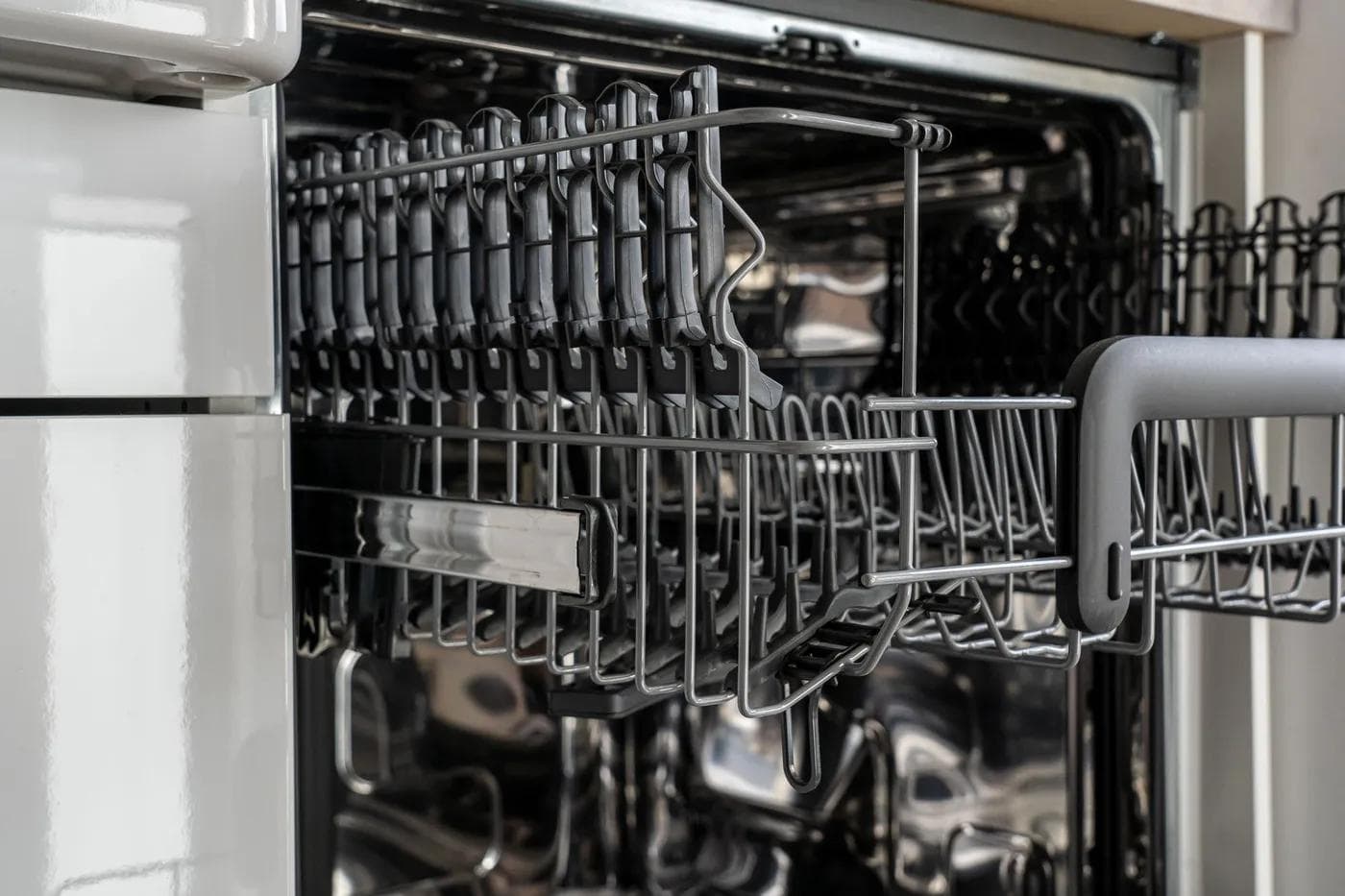
Pull the lower rack out. The lower spray arm either lifts off its hub or unscrews, depending on the brand. The upper arm is usually clipped to the underside of the upper rack or mounted on the back wall; most pull or twist off without tools. Check your manual if it resists.
Hold each arm up to a window or a bright light and look through the holes. On a clean arm, every hole is a clear circle. On a scaled arm you will see holes that are visibly narrowed, holes with a white or grey crust around the rim, and holes that are blocked entirely. Run a finger along the top surface; a rough, chalky texture is calcium carbonate. Tap the arm on a towel and see if white grit falls out, which is scale that has broken loose inside the arm and is now rattling around blocking jets from the inside.
Then look at the rest of the dishwasher:
- The heating element, if the unit has one, will have a white crust where scale has baked on.
- The tub floor around the filter will show a dull, chalky film.
- The door gasket and the inside of the door, where water sits between cycles, will have white streaks.
- The filter itself, at the bottom of the tub, will have scale on its mesh in addition to the usual food debris.
If most holes on either arm are visibly restricted, scale is your problem. Cleaning will restore performance without any parts. If the holes are clear and the dishes are still dirty, the fault is elsewhere: a clogged filter (the homeowner check), a wash pump motor, or a control problem, and that is a diagnostic call.
One more check before you reach for the citric acid: if the dishwasher is a Bosch and the dishes are clean but wet, that is rinse aid, not scale. Bosch units dry through rinse aid sheeting, and an empty dispenser produces exactly that symptom.
Citric acid soak procedure
Citric acid is the right tool. It dissolves calcium carbonate effectively, it is food-safe, and it does not degrade the rubber seals the way repeated vinegar soaks can. Food-grade citric acid powder is sold in the canning aisle and online for very little money.
What you need: citric acid powder, a container deep enough to submerge the spray arms, warm water, a wooden toothpick or a thin plastic pick, an old toothbrush, and about an hour.
- Remove both spray arms as above. Note which way each one mounts so you reinstall them correctly.
- Mix the soak. Roughly two tablespoons of citric acid per litre of warm water, warm from the tap rather than boiling. Stir until dissolved. Make enough to cover the arms completely.
- Submerge the arms and leave them for 30 to 45 minutes. Heavily scaled arms can go an hour. You will see fizzing at the holes as the acid works on the deposits.
- Clear each hole. Lift the arms out and push the toothpick through every hole. Use a wooden or plastic pick, never a metal one; metal enlarges the holes and changes the spray pattern permanently. Loose scale inside the arm will break up as you work; shake the arm over the sink to get it out, and flush it through the hub opening with warm water until the water runs clear.
- Scrub the outer surface with the toothbrush dipped in the soak to remove the crust from around each hole and along the seams.
- Rinse thoroughly with warm water and hold each arm up to the light again. Every hole should now be a clean circle. Repeat the soak on any that are still restricted.
- While the arms soak, pull the filter from the tub floor, rinse it, and let it sit in the same solution for the last 15 minutes. Wipe the tub floor, the door gasket, and the heating element with a cloth dipped in the soak.
- Reinstall the filter and both arms, and spin each arm by hand to confirm it rotates freely.
- Run a hot cycle, empty, with a dishwasher cleaner tablet or a cup of citric acid solution in the detergent compartment. This descales the pump, the internal lines, and the parts you cannot reach.
The first wash afterwards is usually a visible improvement. If it is not, the problem was never the spray arms, and it is time for a diagnostic.
Monthly descaling cycle setup
Cleaning the arms once resets the dishwasher. Keeping it reset on EVMWD water takes a routine, and the routine is light if you actually do it.
Every month in a busy household, every three months at minimum, run an empty hot cycle with a citric acid dishwasher cleaner. Grocery-store tablets labelled for dishwasher cleaning are fine; check the ingredients for citric acid. A heaped tablespoon of citric acid powder in the detergent compartment does the same job for less. Set a repeating reminder; the whole value of this is that it happens before the scale builds.
Every wash, use rinse aid. Rinse aid lowers the surface tension of the final rinse water so it sheets off the dishes and the dishwasher's internal surfaces instead of drying in place and leaving its minerals behind. Keep the dispenser full. This is the single habit that most slows deposition.
Every six months, pull the spray arms and do the light-test inspection. If the holes are starting to narrow, soak them. Catching it at six months is a 20-minute job; catching it at three years is the full procedure above and a season of poor washes.
Every six months, clean the filter properly, not just a rinse. Scale on the filter mesh traps food debris and the two together restrict the pump intake.
Two things that do not help: running the dishwasher hotter, which deposits scale faster, and adding more detergent, which leaves more residue to combine with the minerals. Softer water, not harder cleaning, is the answer if the routine feels like too much.
When professional spray arm cleaning is needed
Most Lake Elsinore homeowners can do everything above. Call instead when:
The arms will not come off. Some models, particularly older ones and some built-ins, have arms that are fastened or seized by scale at the hub. Forcing them cracks the hub or the arm. We remove them properly.
The holes do not clear. Scale that has been accumulating for many years can calcify beyond what a 45-minute soak dissolves. A professional clean uses a longer, stronger soak and the right tools, and it is $95 with the $89 diagnostic fee waived. Compare that with the $180 to $350 a generalist would charge to replace the arm assembly, which addresses the symptom and leaves the water quality problem for the next arm.
The arm spins but the wash is still poor. The fault may be upstream: a scaled or failing wash pump, a diverter valve on a Bosch, a blocked internal line. Those are diagnostic calls, and the scale check is part of every dishwasher repair diagnostic we run.
It is a premium unit. Bosch Benchmark and KitchenAid dishwashers use pump and diverter designs with their own service considerations, and a Bosch showing E15 alongside poor washing has a leak that needs finding, not a spray arm problem.
There is a second symptom. Poor washing plus a grinding noise, plus a failure to drain, plus a leak, or plus a dead panel means more than one thing is going on, and the cheapest path is one diagnostic rather than several guesses.
What a professional clean includes: both arms removed and descaled, the hubs and seals inspected, the filter and sump cleaned, the heating element descaled, the door gasket and tub cleaned, a check of the inlet valve screen for scale, and a test cycle. If the dishwasher has a problem beyond scale, you get a flat-rate quote before any further work.
Pairing descaling with water treatment
Descaling treats the symptom. The minerals keep arriving every time the dishwasher fills, and on untreated EVMWD water at 135 to 160 ppm, the routine above is permanent.
The way to make it occasional is to treat the water. A whole-house salt-based softener, $1,500 to $3,500 installed, brings the supply to 20 to 40 ppm. At that hardness the spray arms stay clear for years, rinse aid does its job with less effort, and the quarterly descaling cycle becomes a twice-yearly precaution. Dishwashers in Lake Elsinore homes with a working softener are, in our experience, dramatically less likely to need a scale-related visit.
Two cautions. A salt-free conditioner is sold as a softener but does not remove the calcium; it changes how it crystallises. That helps heating elements and pipes and does little for the small holes in a spray arm, so if your main motivation is the dishwasher, a conditioner is the wrong purchase. And a softener that has quietly stopped working, from exhausted resin or an empty salt tank, protects nothing. If you already have one and the scale has come back, test the water before you blame the dishwasher.
An under-sink reverse osmosis filter, which we often recommend for refrigerator ice makers, does not help the dishwasher, because the dishwasher is plumbed to the hot supply under the sink rather than the filtered line.
If you want to know how far the scale has progressed before deciding on treatment, that is what the diagnostic is for. We look at the arms, the valve screen, and the element, tell you what we found, and leave the treatment decision with you.