Nobody books a service call because their ice is cloudy. They book one when the ice stops. But the cloudy, specked, odd-tasting cubes that came out of the dispenser for the two years before that were the ice maker telling you what was happening inside it, and in Lake Elsinore the message is almost always the same: hard water.
This guide separates the ice that is fine from the ice that is a warning. It covers why ice clouds in the first place, what the white specks are, where bad taste comes from, which ice symptoms mean the ice maker is actually failing, and what to do about the water. The mechanics of the damage itself are in our hard water guide.
Normal cloudy ice vs problem cloudy ice
Start with the reassurance: cloudy ice is normal, and your ice maker is not broken because of it.
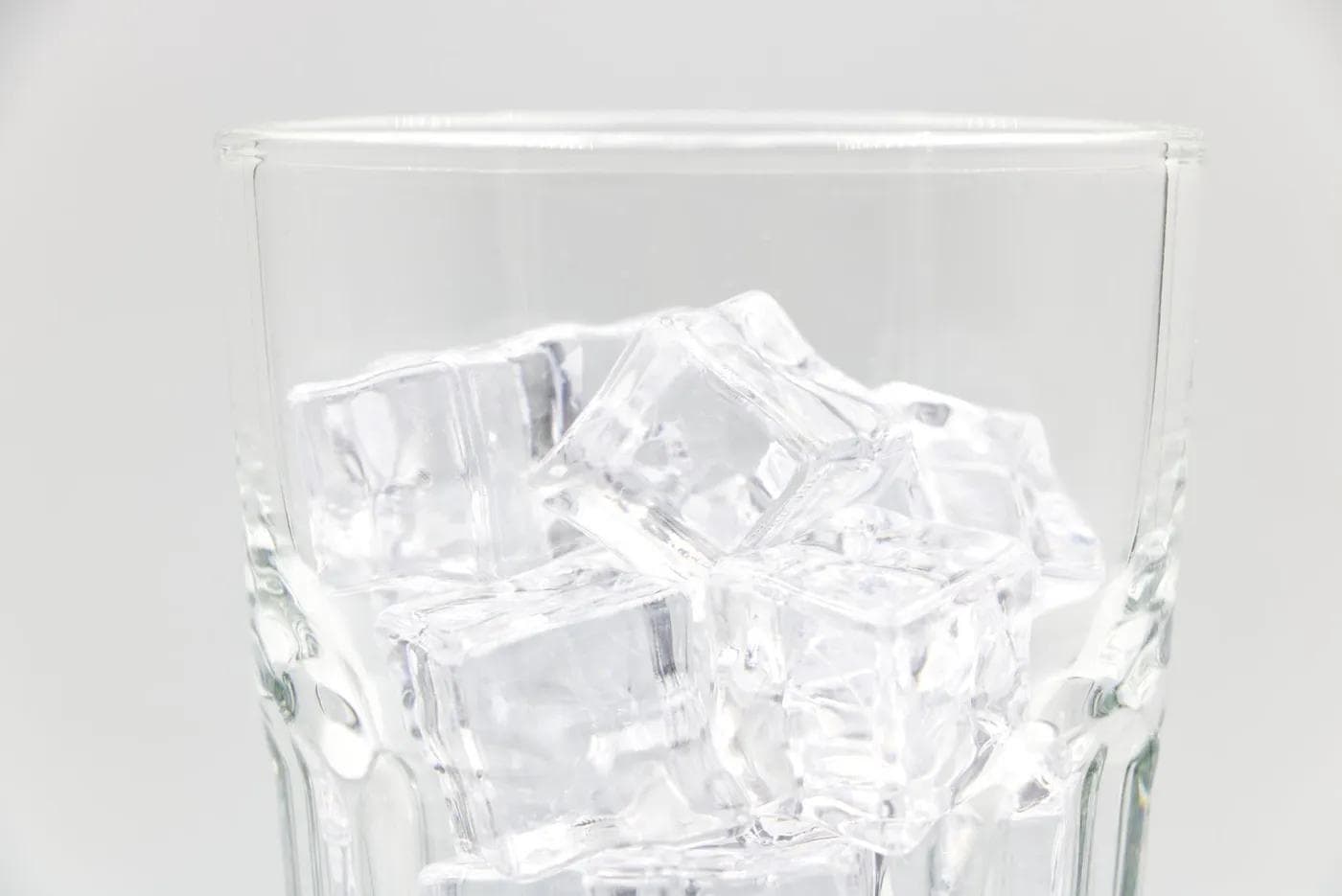
Water contains dissolved air and dissolved minerals. When it freezes slowly from one direction, as it does in a commercial clear-ice machine or a slow-freezing pond, the ice forms in layers and pushes the air and minerals ahead of the freezing front, leaving clear ice behind. A refrigerator ice maker does the opposite. It freezes a small tray of water fast, from every side at once. The outside freezes first, clear. The air and minerals get pushed toward the centre, and when the centre finally freezes they are trapped there as a cloud of microscopic bubbles and crystals. The result is a cube with a clear rim and a white core.
That is every refrigerator ice maker in Lake Elsinore, in Huntington Beach, and in San Francisco. The cloudiness has nothing to do with water quality, except that harder water with more minerals will show a slightly denser cloud.
Problem cloudy ice looks different, and it comes with company:
- Cubes that are uniformly white or opaque, rather than clear-rimmed with a white core, suggest the water is not freezing in the normal pattern, often because the fill was short and the tray froze fast and thin.
- Cubes that are small, hollow, or oddly shaped mean the tray is not filling fully. That is a water flow problem, not a freezing problem.
- Cubes that stick together in a slab mean the ice is partially melting and refreezing, which points to a freezer temperature problem or a door being left ajar.
- Cloudy ice that smells is a taste problem, covered below.
If your ice is cloudy and otherwise normal, nothing is wrong. If it is cloudy and small, cloudy and slow, or cloudy and strange-tasting, keep reading.
White specs: mineral deposits from hard water
Hold a Lake Elsinore ice cube up to the light and you will often see white specks, sometimes a fine white sediment that settles in the glass as the ice melts. That is calcium carbonate, and it is EVMWD water showing you its hardness.
The district's supply runs 135 to 160 ppm hardness, in the hard category on the standard scale. When water with that mineral load freezes, the minerals do not freeze with it; they are concentrated into the last liquid to solidify, and in a fast-freezing cube that is the centre. Where the concentration is high enough, the minerals come out of solution as visible specks. In a glass of water from a softened supply at 20 to 40 ppm, you will not see them.
The specks are harmless. Drink the water, chew the ice. What they tell you is the useful part: the same minerals precipitating in your ice are precipitating inside the ice maker, where they cannot be seen.
The damage pattern is predictable. In years one to three, scale begins accumulating inside the water line and on the inlet valve solenoid, and ice production is normal. In years three to five, flow reduces measurably and cubes get slightly smaller. In years five to eight the line restricts, production drops, and the inlet valve begins failing intermittently. Past eight years, the valve fails, the line is severely restricted, and the module may fail from cycling with insufficient water. The specks in your ice in year two are the same minerals that block the line in year six.
Our ice maker repair diagnostic follows the water path for exactly this reason: check the line, check the valve, check the module, in that order. Starting with the module and replacing it when the real problem is a blocked line is one of the most common misdiagnoses we correct on second-opinion calls.
Taste issues: filter age vs water quality
Bad-tasting ice has three usual sources, and they are easy to tell apart.
The filter is old. Every modern refrigerator with a water dispenser and ice maker has a replaceable filter, and it should be replaced every six months. Most are not. An exhausted filter stops removing chlorine and organic compounds, and the ice starts tasting of whatever is in the supply. If the ice tastes flat, chemical, or faintly of chlorine, and the filter has been in longer than six months, replace it before doing anything else. This is a homeowner task and the most common fix.
Mineral build-up in the ice maker tray. Over years on hard water, scale coats the inside of the tray where the cubes form. Water sitting against that scale between cycles picks up a mineral taste, and the first cubes after a quiet period taste worst. The filter does not help here, because the deposit is downstream of it. Cleaning the tray is a technician job and is part of ice maker service.
Odour transfer. Ice absorbs smells. An open container of onions, a leaking package of fish, or an old box of baking soda in the freezer will flavour the ice. If the ice tastes of food rather than minerals or chemicals, the fix is in the freezer, not the water. Empty the ice bin, clean the freezer, and let a fresh batch form.
A quick way to narrow it down: taste the dispensed water. If the water tastes fine and the ice does not, it is the tray or the freezer. If both taste off, it is the filter or the supply.
Taste is also where the refrigerator filter and real water treatment part ways. The filter improves taste and removes chlorine; it does not remove hardness. Lake Elsinore ice will carry a mineral note and white specks on any filter, because the filter is not designed to take out calcium. That takes reverse osmosis or a softener, covered below.
When ice problems indicate ice maker damage
Some ice symptoms are cosmetic. Others are the first visible stage of a repair. Here is how we read them.
Small or hollow cubes. The tray is not getting its full fill. In Lake Elsinore the usual cause is restricted flow: scale in the water line, an inlet valve that opens but not fully, or low household water pressure. Small cubes are the year-three-to-five stage of the hard water pattern, and the cheapest point to intervene. A water line cleaning runs $95 to $150 and often solves it outright.
Production has slowed. The bin used to fill overnight and now takes two days. Same cause, further along. The line is more restricted, and the valve may be starting to stick. If the ice maker is also cycling with no ice, the module is trying to harvest a tray that never filled.
Ice stopped entirely. Three usual causes in Lake Elsinore homes: a blocked line ($95 to $150 to clean), a failed inlet valve ($150 to $220), or a failed module ($180 to $320). The diagnostic tells which, and the order matters, because replacing the module when the line is blocked just gives you a new module cycling dry.
Water on the freezer floor or inside the ice compartment. A cracked fill tube or a valve that no longer closes fully. The valve case is a hard water failure: scale on the valve seat prevents it from seating, and it leaks into the fill tube, where the water freezes and blocks it.
The ice maker makes noise but produces nothing. A stuck ejector arm or a failed module motor. Some modules have a reset that restores function; the diagnostic identifies whether reset or replacement is needed.
Cloudy, specked, mineral-tasting ice with none of the above. Not damage. Yet. It is the water telling you what it is doing to the ice maker, and the right time to decide about treatment is now rather than at the year-eight cascade.
Any of these on a Samsung, LG, Whirlpool, or Sub-Zero ice maker follows the same sequence, with brand-specific parts. Samsung ice makers in particular have well-documented failure modes that hard water accelerates; the Samsung repair page covers them.
Water treatment options for better ice
If you want clearer, cleaner-tasting ice and, more importantly, an ice maker that lasts, there are three realistic options.
Replace the refrigerator filter every six months. Not a substitute for the others, but it slows scale accumulation and fixes most taste complaints. Set a reminder; the six-month interval is the one most households miss.
Under-sink reverse osmosis filter on the refrigerator line. This is the option we most often recommend for ice specifically. An RO system removes most dissolved minerals from the one line it is plumbed to, so the ice maker gets nearly mineral-free water. The ice is visibly clearer with fewer specks, the taste improves noticeably, and the line, valve, and module stop scaling. Installation is $500 to $900 with cartridge changes every 6 to 12 months. It protects only the refrigerator, which for many households is the appliance they care most about. Payback is fast, because one avoided valve-and-module cascade covers most of the cost.
Whole-house water softener. $1,500 to $3,500 installed, bringing the entire supply to 20 to 40 ppm. The ice maker benefits the same way, and so do the dishwasher, the washer, and the water heater. Payback across all of them is typically three to five years. If the ice maker is one of several appliances showing hard water symptoms, this is the better investment. A salt-free conditioner is not a substitute for this purpose; it does not remove the minerals and the specks will remain.
A word on the ice maker itself: once scale has restricted a line or corroded a valve, treatment stops further damage but does not undo what is there. If production has already slowed, have the line cleaned and the valve checked, then add the treatment. The combination is what gets a Lake Elsinore ice maker to the end of the refrigerator's life.
And if the ice is simply cloudy, with full-size cubes, normal production, and no off taste, do nothing. That is what refrigerator ice looks like, and it is fine.