
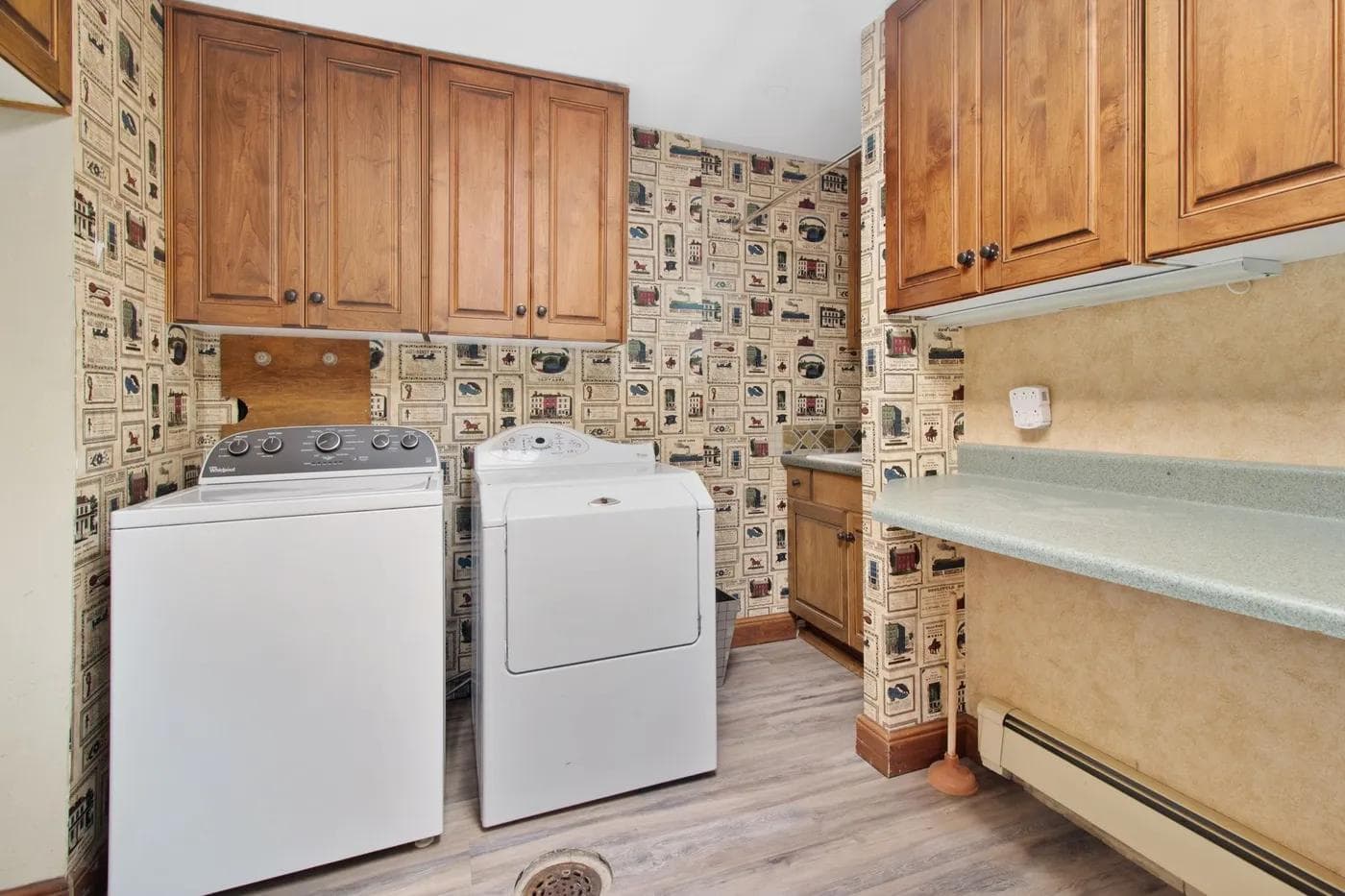
The most common dryer call we take in Canyon Hills is not a broken dryer. It is a working dryer connected to a vent that has quietly filled with lint, in a house whose floor plan made that inevitable. The homeowner has usually already replaced the lint trap, run the dryer empty, and started pricing a new machine.
This guide explains why Canyon Hills vent runs are longer than average, what that does to lint accumulation, how we tell a vent problem from a dryer problem in a few minutes, why long runs need professional equipment, and how often to have them cleaned. It is specific to the two-storey builds that make up most of the community, which we describe on the Canyon Hills service page.
Why Canyon Hills vent runs are longer than average
In a single-storey home, the laundry room usually sits on an exterior wall. The dryer vent goes straight out: a short transition duct, a metre or two of rigid duct, an exterior cap. Airflow is strong and lint has nowhere to collect.
Canyon Hills is a master-planned community built from the mid-2000s onward, and most of its floor plans are two-storey family homes. In many of those plans the laundry room is upstairs, or on an interior wall downstairs, or tucked into a closet off a hallway. From there the vent has to find its way to an exterior exit: up through a wall cavity, across a ceiling, around a corner, and out through a roof cap or a wall cap on a different elevation of the house.
The result is a run that can be several times the length of a single-storey vent, with two, three, or four 90-degree bends. Each bend adds the airflow resistance of a few metres of straight duct. A run that looks like five metres on the plan can behave like fifteen metres of resistance to the dryer's blower.
That is not a construction defect. It is a normal consequence of putting the laundry where families want it. It does, however, mean a Canyon Hills dryer vent needs to be thought of as a system with its own maintenance schedule, not a pipe that takes care of itself.
How long vents accumulate lint faster
Lint escapes the trap on every load. The trap catches most of it, but a steady fraction travels into the duct carried by the exhaust air. What happens next depends entirely on airflow.
In a short, straight run the air is moving fast enough to carry that lint all the way out the exterior cap. In a long run with bends, air speed drops along the duct, and at every bend the air changes direction while the heavier lint fibres try to keep going straight. They hit the outer wall of the bend and stick. The first fibres roughen the surface, the next ones catch on them, and a mat starts to form. Once a mat exists, it narrows the duct, slows the air further, and makes the next fibre more likely to settle.
This is why lint load in a long vent is not linear. It builds slowly for the first year or two and then accelerates. A Canyon Hills home that has never had the vent cleaned, six or eight years after construction, often has a duct that is more than half blocked at the first bend above the laundry room, with the mat extending back toward the dryer.
Two other factors in Canyon Hills make it worse. Vertical sections let damp lint settle under gravity when the dryer stops, so the bottom of any vertical run becomes a collection point. And Santa Ana season dust, pulled into the laundry room and the dryer, binds with lint into a denser, heavier deposit than lint alone.
The dryer responds to all of this in a way that hides the problem. Modern dryers have an airflow sensor. When the vent restricts, the sensor sees reduced flow and the control reduces heat output to prevent overheating. The dryer does not break. It just takes longer, and longer, and longer.
Diagnostic approach for "takes forever to dry" symptoms
When a Canyon Hills homeowner tells us the dryer takes two cycles, we do not start with the dryer. We start by separating the two possible causes, and it takes about ten minutes.
Step one: the disconnect test. Pull the dryer out and disconnect the transition duct from the back of the machine. Run a normal cycle with the exhaust venting straight into the laundry room (a towel over the outlet keeps the lint contained). If the dryer dries a load in its normal time, the dryer is healthy and the vent is restricted. If it still underperforms, the fault is inside the dryer.
Homeowners can do this test themselves, and it is the single most useful thing to try before booking anyone.
Step two: if the dryer is at fault. The common culprits are a failing heating element on an electric dryer ($180 to $350 with labour), a failed gas valve coil ($150 to $250) or igniter ($180 to $280) on a gas dryer, or a failed high-limit thermostat. A blown thermal fuse is also common, and it is a clue: the fuse blows from overheating, and the overheating almost always comes from restricted airflow. A dryer that needed a thermal fuse has usually also needed its vent cleaned for a while.
Step three: if the vent is at fault. Measure airflow at the exterior cap with the dryer running on air-only. Weak flow confirms the restriction. Then trace the run: locate the exit, note the elevation and the likely path through the structure, and check the transition duct and the wall connection for crushing, kinks, and material. In Canyon Hills we also check for bird nests at the cap, which are common on roof and high wall exits.
Step four: the secondary symptoms. While the dryer is pulled out, look for the signs that the restriction has already caused heat damage: scorching on the back panel, a transition duct that has discoloured, lint packed against the blower housing. These change the job from a cleaning to a cleaning plus a repair.
On a dryer repair call, the vent inspection is included every time, because the answer is so often there. If the diagnostic shows the vent is the whole problem, we charge for the vent cleaning only.
Professional cleaning for long vent runs
A homeowner with a brush kit can clean the first metre or two of duct behind the dryer. That is worth doing. It does not reach the problem in a two-storey home.
The lint mat in a Canyon Hills vent sits at the first bend above the laundry room and in the vertical section after it, often inside a wall cavity. A handheld brush does not turn corners well, cannot push a rigid mat ahead of it, and will not clear a vertical section against gravity. Pushing too hard separates a duct joint inside the wall, which is worse than the lint.
Professional cleaning uses a rotary brush on flexible rods driven from the dryer end, combined with a high-volume vacuum pulling from the same end, so the lint comes back toward the machine rather than being packed further up the run. Where access allows, we also work from the exterior cap toward the dryer so the mid-run is cleared from both directions. The run is then tested for airflow at the cap to confirm it is back within the dryer's specification. If airflow is still weak after cleaning, the restriction is structural: a crushed section, a separated joint, a sagging flexible section, or the wrong duct material, and that is a repair rather than a cleaning.
The exterior cap gets its own inspection. On Canyon Hills roof and high-wall exits, caps with damaged louvres or long-term bird nesting are replaced ($40 to $100 depending on the model).
Standard vent cleaning in Lake Elsinore costs $150 to $250 depending on length and access. Canyon Hills two-storey runs sit toward the top of that range because they are longer and harder to reach, and the job typically takes 60 to 90 minutes rather than 45. Our dryer vent cleaning page lists what the service includes.
Frequency recommendations for Canyon Hills homes
The annual cleaning that suits a single-storey home is not enough for most of Canyon Hills. Long runs load faster, and the consequences of a blocked run are higher in a community with wildfire-adjacent edges.
Our schedule for Canyon Hills households:
- Every 6 to 8 months for a typical two-storey home doing a normal family load volume. This is the baseline here, not the exception.
- Every 6 months, without stretching for households doing more than three loads a week, families with young children, or homes with pets that shed.
- Every 3 to 4 months during Santa Ana wind season for homes on the edges of the community that sit near open vegetation. The dry-wind period raises the consequence of any dryer fire enough to justify the extra visit.
- Immediately for any dryer that has started taking noticeably longer, shutting off mid-cycle, or producing any burning smell. The burning smell is the one symptom that means stop using the dryer now.
Between cleanings, the homeowner habits that make the most difference are simple: clear the lint trap every load, wash the trap screen monthly to remove dryer-sheet film, keep the area behind the dryer clear so the transition duct is not crushed, and once a season go outside and confirm the exterior flap opens strongly while the dryer runs.
If you have not had the vent cleaned since the house was built, or you cannot remember when it was last done, treat that as the trigger. The first cleaning on a long run that has been loading for years is the one that restores the dryer you thought you had lost.