Living in Lake Elsinore comes with perks: stunning lake views, access to the Ortega Mountains, and year-round sunshine. But there is a hidden cost to our valley lifestyle. We call it the “Valley Tax” on home equipment.
If you have ever wondered why your washing machine started leaking after only five years or why your AC unit seems to wheeze every August, it isn’t just bad luck. It’s the microclimate. The specific combination of extreme heat, afternoon winds, and mineral-heavy water in Lake Elsinore wages a constant war on your appliances.
At Appliance Repair Lake Elsinore, we see the aftermath of this daily. We know that a manufacturer’s “10-year warranty” often means 7 years in Riverside County if you don’t take specific precautions. The good news? You can fight back. By understanding exactly how our environment attacks your home systems, you can double their lifespan with a few strategic moves.
The 100°F Threshold: How Extreme Heat Cooks Capacitors
You know how it feels when the temperature hits 105°F in July. Your appliances feel it too, but they can’t sweat to cool down.
The Science of “Heat Soak”
Most appliance motors and control boards are rated to operate safely in ambient temperatures up to roughly 90°F-100°F. When Lake Elsinore hits 105°F or 110°F, the internal temperature of a running motor can spike well above its safety rating.
The most vulnerable component is the capacitor. This small, battery-like part gives your AC compressor and refrigerator motor the “kick” they need to start. High heat degrades the chemical paste inside the capacitor. Once that paste dries out, the capacitor fails, and your compressor tries to start but can’t. It hums, overheats, and eventually burns out. Replacing a $50 capacitor is cheap; replacing a $2,000 compressor is not.
The Garage Fridge Trap
Many of us have a second fridge in the garage for drinks and Costco runs. In coastal cities, this is fine. In Lake Elsinore, uninsulated garages can reach 120°F in the summer.
Standard residential refrigerators are designed for indoor climates (60°F – 80°F). When the air outside the fridge is 110°F, the compressor has to run 24/7 just to keep the ice cream frozen. This constant running doesn’t just spike your electric bill—it creates a massive strain that burns out the compressor in half the expected lifespan.
Pro Tip: If you must have a garage fridge, ensure it is “garage-ready” (designed for extreme ambient temps) or install an inexpensive ventilation fan in your garage to keep the air moving.
The “Ortega Wind” Effect: Grit, Dust, and Condenser Coils
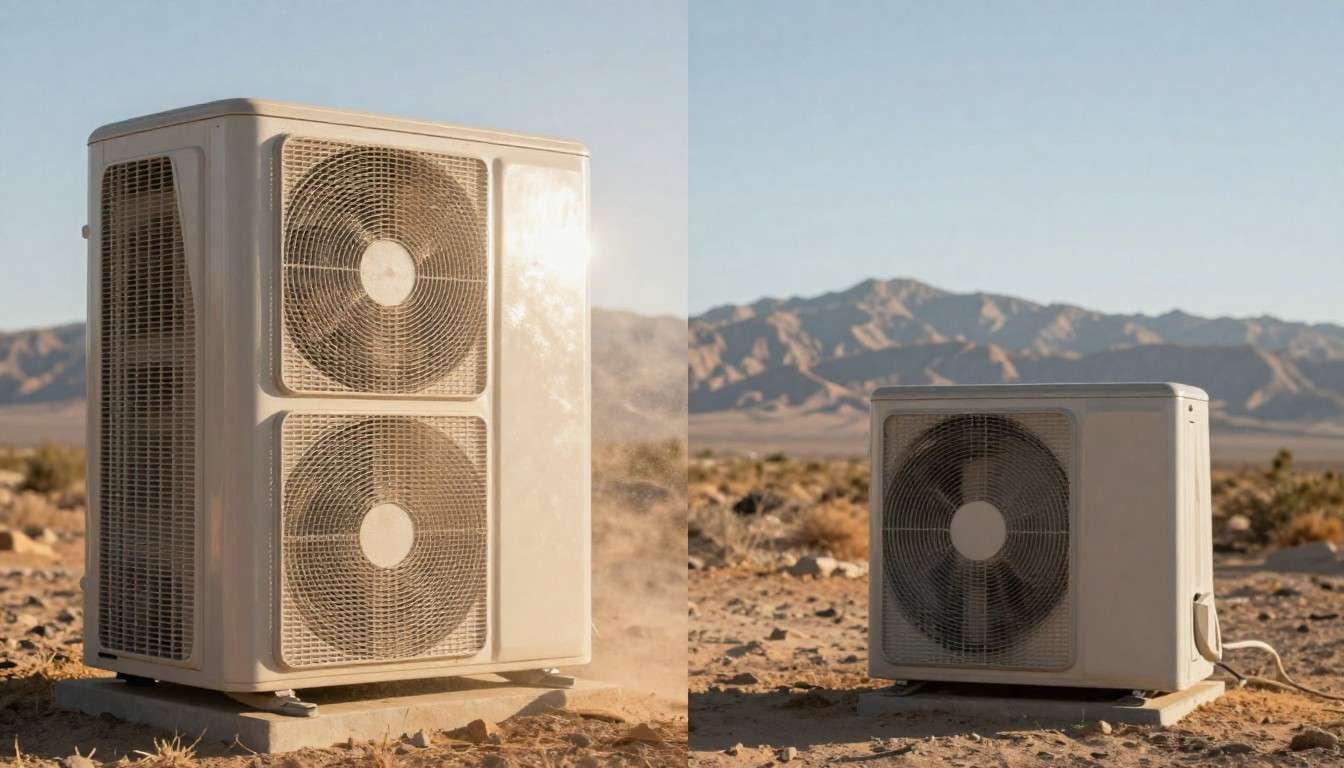
If you live near the base of the mountains or in the open valley, you know the afternoon drill: the wind picks up, and with it comes a fine layer of dust and grit.
The Sandblaster Effect
Your outdoor AC unit pulls air through its sides to cool down the hot refrigerant gas. When that air is full of dust from the Ortega winds, two things happen:
- Clogging: The dust coats the aluminum fins of the condenser coil. This acts like a winter coat, trapping heat inside the unit.
- Erosion: Over years, high-speed grit can physically erode the delicate metal fins, reducing efficiency.
When a coil is clogged, your AC can’t release heat. The system pressure skyrockets, and the compressor has to work 30% harder to provide the same amount of cooling. We often find units that are theoretically “fine” but are drawing double the electricity because they are suffocating under a layer of Lake Elsinore dust.
The Hard Water Reality: EVMWD Supply & Your Plumbing
Water quality is the single biggest killer of water-using appliances in our area. The Elsinore Valley Municipal Water District (EVMWD) provides safe water, but it is naturally high in mineral content (calcium and magnesium) due to our groundwater sources.
The “Rock Layer” Inside Your Machines
When hard water heats up, the minerals separate and bond to surfaces. This creates scale.
- Dishwashers: Scale coats the heating element. Instead of heating water directly, the element has to heat the rock layer first, then the water. This causes the element to overheat and crack.
- Water Heaters: Sediment builds up at the bottom of the tank. You might hear a “popping” or “rumbling” noise—that is steam bubbles trapped under a layer of sediment, literally cooking your tank from the inside out.
The Valve Killer
Sediment is abrasive. As it flows through the tiny solenoid valves in your washing machine and refrigerator ice maker, it scratches the seals. Eventually, the valve can’t close all the way. This is why you wake up to a slow drip from your fridge dispenser or a washing machine drum that fills with water even when it’s off.
Dry Air & Brittle Rubber: The Silent Leak Causer
While we worry about heat, we ignore the lack of humidity. Single-digit humidity levels are common here, and rubber hates dry air.
Rubber gaskets, door boots on front-load washers, and inlet hoses contain plasticizers to keep them flexible. In our dry climate, these evaporate faster. A rubber hose that would last 10 years in Florida might crack and burst in 5 years here.
The most dangerous failure point is the washing machine supply hose. If it bursts while you are at work, it pumps hundreds of gallons of water into your home.
The “Crack Test”: Go to your washing machine right now. Bend the black rubber hose. If you see tiny hairline cracks in the surface, it is a ticking time bomb. Replace it immediately.
The Voltage Volatility: Grid Strain and Power Surges
During a heatwave, everyone in Lake Elsinore cranks their AC at 4:00 PM. This massive demand strains the local grid, leading to voltage fluctuations or “brownouts” (dips in power) followed by surges when the load stabilizes.
Old appliances with mechanical timers didn’t care about this. But your modern “smart” stove and washing machine have sensitive computer boards. A voltage drop can confuse the board, and the subsequent surge can fry it. We replace dozens of main control boards every summer after major heatwaves.
Protection Strategy: You don’t need to unplug everything. Install a whole-home surge protector at your breaker panel. It costs a fraction of the price of a new dryer and protects every outlet in the house.
Lake Elsinore Survival Guide: The 2026 Maintenance Playbook
You can’t change the weather, but you can change your maintenance routine. Here is the schedule we recommend for our local customers.
1. The Filter Schedule: Forget “Every 3 Months”
The standard advice says change your AC filter every 90 days. In Lake Elsinore, that’s too long.
- Summer/Fall: Change it every 30 to 45 days. The dust load is too high to wait.
- Winter: Every 60 days is usually fine.
- Why: A dirty filter restricts airflow, which is the #1 cause of frozen coils and compressor death in our area.
2. The Descaling Routine
Fight the hard water actively.
- Dishwasher: Once a month, place a cup of white vinegar in the top rack and run a hot cycle (empty). This dissolves early mineral buildup.
- Coffee Maker: Descale every 30 days, not when the light blinks.
- Washing Machine: Run a “clean washer” cycle with a dedicated descaling tablet (like Affresh) monthly.
3. The “Sunset” Rule
Give your appliances a break during the hottest part of the day (2 PM – 6 PM).
- Run the dishwasher and dryer after sunset. This keeps the ambient heat load down in your kitchen and garage, helping your AC keep up and preventing your appliances from overheating.
- Plus, if you are on a Time-of-Use plan with SCE, this saves you money.
4. Rinse Your Condenser
You don’t need a chemical wash every week, but you do need to rinse the dust off.
- Turn off your AC at the thermostat.
- Take a gentle garden hose (no high-pressure nozzles!) and rinse the outdoor unit from top to bottom.
- Do this once in May (pre-summer) and once in November (post-Santa Ana winds). This simple 5-minute task can lower your electric bill by 10%.
Conclusion: Adapt Your Care to Your Climate
Living in Lake Elsinore requires a different approach to home maintenance. The environment is harsher, so your care needs to be smarter. You don’t have to accept that your appliances will die early. With better airflow, cleaner water, and surge protection, you can get full value out of every machine in your home.
If you suspect your AC is already struggling with the heat or your dishwasher is losing the battle against hard water, don’t wait for a total breakdown. Appliance Repair Lake Elsinore is here to help you weather-proof your home. Let’s get your systems running efficiently so you can get back to enjoying the view.